


Lot n° 263
Estimation :
4000 - 6000
EUR
Result without fees
Result
: 8 500EUR
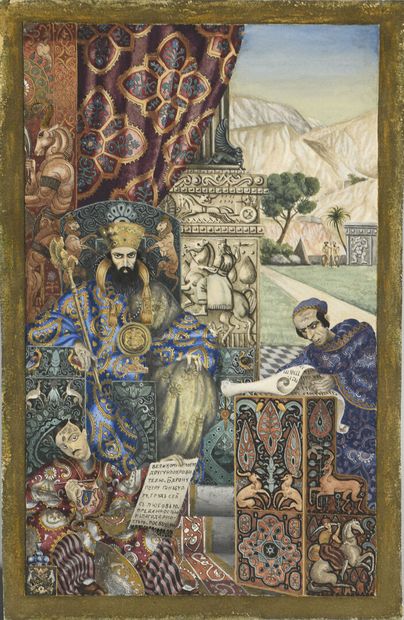
Ivan BILIBINE (Tarkhovo 1876 - Saint Petersburg 1942) - Lot 263
Ivan BILIBINE (Tarkhovo 1876 - Saint Petersburg 1942)
Illustration project
Pen and black ink and watercolor and gouache
24 x 15.5 cm
Dedicated lower left on parchment, in Cyrillic To the great friend and "patron", Baron Pierre Gunzburg...
Born into an old Russian family, Bilibine studied art in Saint Petersburg and Munich. He was greatly influenced by one of his masters, Ilia Répine, and by the work of the Mir Iskousstva (The World of Art) association, of which he was a member.
On a trip to the Tver government in 1899, he discovered Russian folk culture, from which he was to draw inspiration for a type of illustration of his own, later called the Bilibine Style. Between 1902 and 1904, he traveled throughout Russia, commissioned by the Ethnographic Museum to collect documents on Russian folk culture, ranging from handicrafts and embroidery to photographs of traditional architecture.
He devoted most of his work to illustrating Russian folk tales and Pushkin's novels... He also created theater sets, notably for Rimsky-Korsakov's The Golden Cockerel in Moscow in 1909.
Bilibine left Russia after the 1917 revolution. He settled in Paris, where he worked for French publishers and Russian émigré publications, as well as for numerous theaters. He exhibited in several countries. During this period, he also drew inspiration from Breton culture in his illustrations.
In 1936, he returned to Leningrad, where he died during the blockade.
Our drawing is dedicated to Baron Pierre de Gunzburg (Lausanne 1872 - Paris 1948).
The Gunzburgs, originally from Vilna (Lithuania), were an important family of financiers and philanthropists who first settled in Saint Petersburg. Gabriel Jacob, the Rothschilds' representative in Russia, was made an honorary hereditary citizen of Russia in 1848.
His son Joseph, financier to Russian sovereigns and German princes among others, built up a considerable fortune, notably during the Crimean War. He was one of the Czar's trade advisors and a member of the Jewish Religious Committee in Russia. He was knighted in 1870 by the Duke of Hesse - Darmstadt. He was made a baron in 1874.
His son, Horace de Gunzburg, deeply involved in the Jewish community in Russia, continued to expand the family business. He settled in Paris under the Second Empire, but the family continued to maintain ties with Russia, both in business and through philanthropic ventures and cultural patronage. Pierre de Gunzburg is one of Horace's sons.
This lot is presented by expert René MILLET.
01 44 51 05 90 - expert@rmillet.net
My orders
Sale information
Sales conditions
Return to catalogue